
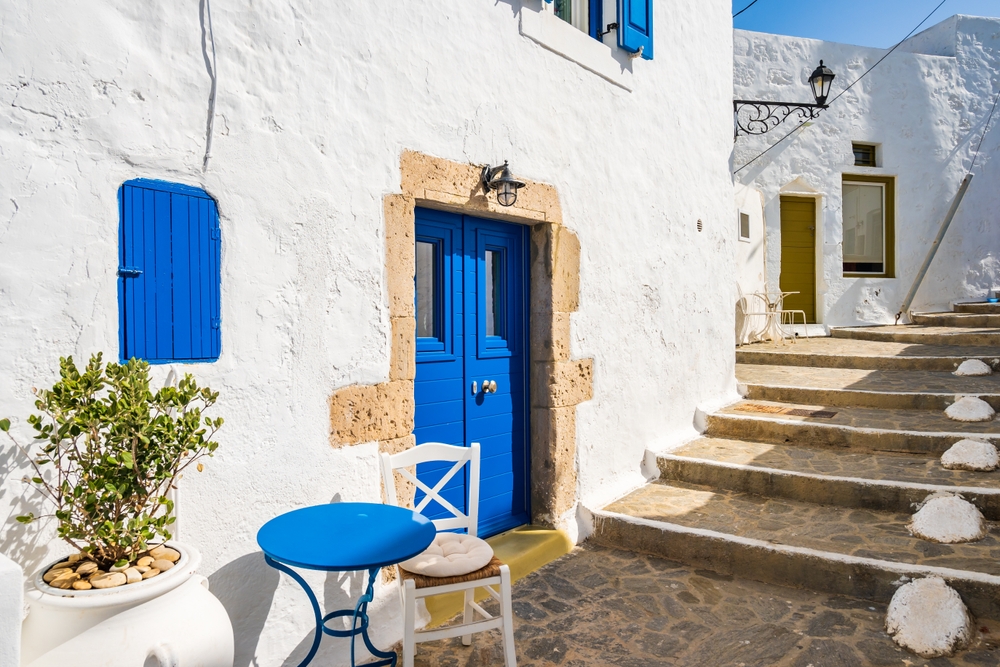
The image of sun-drenched, ivory dwellings—their cobalt shutters framing the infinite Aegean—serves as the quintessential visual signature of the Cyclades. Yet, this idyllic scenery was not born of an artist’s whim; rather, it emerged from a compelling confluence of survival, public health, and strategic political rebranding.

Centuries ago, the Cycladic settlements were designed to be invisible. Constructed from local stone in the muted tones of the arid earth, they had one primary purpose: camouflage against the pirates haunting the archipelago. Only when the threat of piracy receded did white begin to gain ground—not for its beauty, but as the islands’ first “natural climate control.” Lime wash reflected the relentless summer sun, acting as a thermal shield to keep interiors cool.
In 1938, a cholera outbreak fundamentally altered the islands’ aesthetic. The government of the time mandated the whitening of all dwellings with lime, which was then considered the most potent disinfectant available. What began as an emergency sanitary measure eventually bestowed upon the islands that sense of immaculate purity that continues to enchant travelers today.

Contrary to popular belief, the sapphire hue of the shutters was not chosen to mirror the sea, but for its sheer practicality. Islanders used loulaki, a common blue laundry powder found in every household. When mixed with lime, it produced that deep, vibrant azure that would inadvertently become a global trademark.
The transition from tradition to a national brand took place in the mid-20th century. In 1954, Queen Frederica organized the “Cruise of the Kings,” inviting Europe’s elite to the archipelago and projecting the image of a “pristine, white Greece.” This uniformity was later codified between 1967 and 1974, when white and blue were mandated by decree to forge a singular, recognizable tourist identity.

Later, the legendary Melina Mercouri, as Minister of Culture, breathed new life into this aesthetic. She understood that this white was more than just paint—it was the “soul” of the islands. By institutionalizing strict architectural protections, she ensured that the Cycladic spirit would remain untarnished by urban sprawl.
Today, the striking contrast of whitewashed stone against vibrant bougainvillea and cerulean wood is no longer an imposition; it is the very essence of the Greek summer—a timeless dialogue between light and shadow.


