
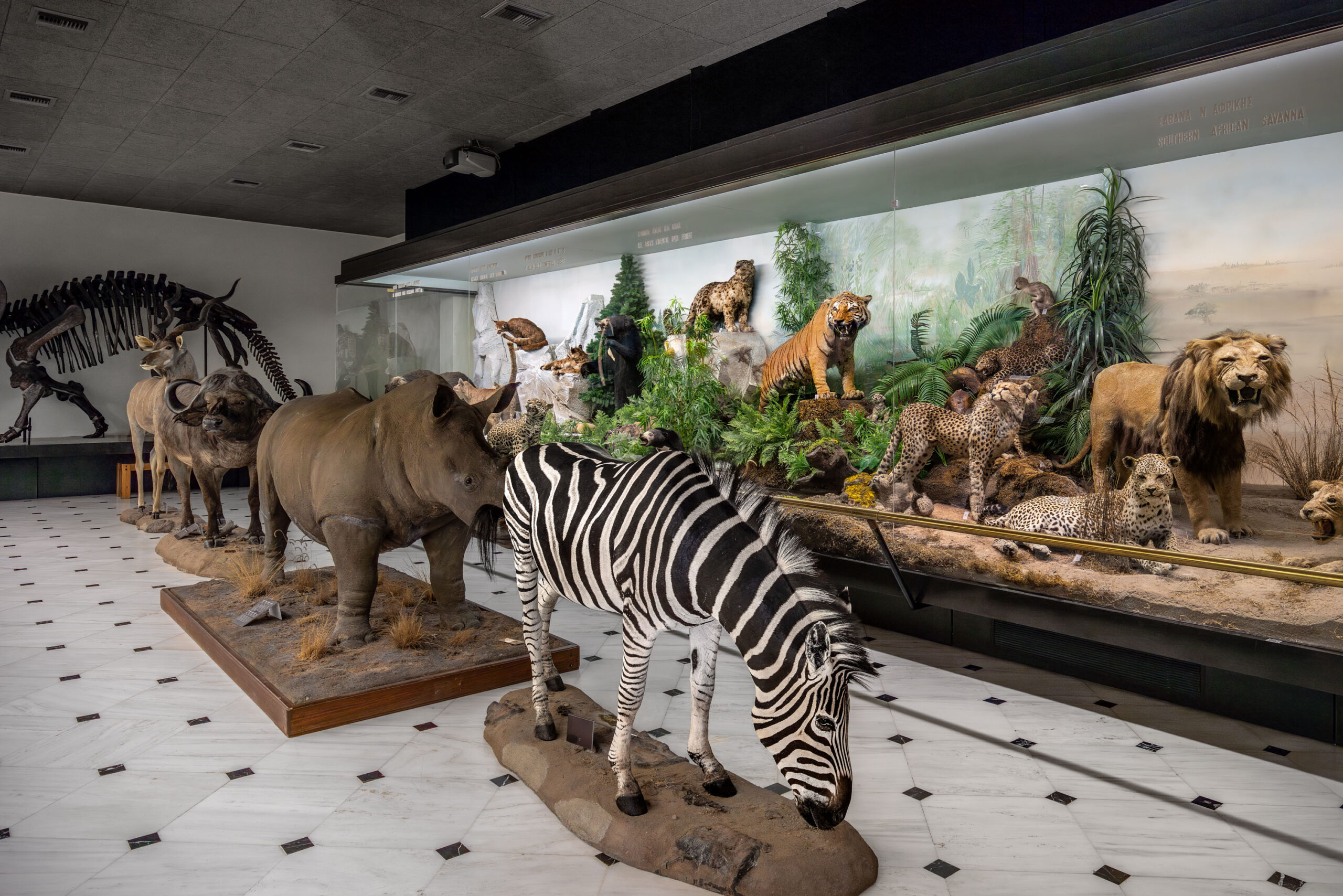
Athens’ new museum of nature is more than just another cultural stop; it’s a living reminder that in the natural world everything is connected – and that we are part of that “everything”

In an age of climate anxiety and ecological information overload, it’s rare to find a place that doesn’t overwhelm you with guilt, but instead helps you feel part of the world again.
The Goulandris National Museum of Natural History in Kifissia does exactly that: it turns knowledge into experience, science into storytelling, and nature into something at once familiar and awe-inspiring.
With its new exhibition “Biodiversity. Everything is connected”, the recently designated National Museum of Natural History reintroduces itself as a living organism: a hub where research, education and our need to see the planet with fresh eyes all meet.
Officially recognised as Greece’s National Museum of Natural History, it crowns almost six decades of scientific research, environmental education and outreach. In practice, Greece now has – for the first time – an institutional “nerve centre” of knowledge about its natural world, comparable to national natural history museums in other biodiversity-rich countries. And that shifts the Museum’s role: from a beloved destination for school visits, it becomes a reference point for understanding the environment and the climate crisis.

“Biodiversity. Everything is connected” – an exhibition about the invisible thread
The new flagship exhibition, created with a grant from the Stavros Niarchos Foundation, takes a word we hear all the time – biodiversity – and turns it into something tangible, moving and deeply personal.
Through interactive digital displays, holographic and panoramic projections, striking audiovisual installations and real specimens, the exhibition illuminates how life is interwoven:
- species struggling to survive over billions of years
- the genes that make each of us unique
- ecosystems where everything coexists – plants, animals, water, soil, climate
- the relationships between organisms and with their environment
Very quickly you realise that biodiversity is not a “list of species” but the web of life to which we all belong. The exhibition doesn’t sugar-coat reality: it focuses on pressures and threats – from climate change to habitat degradation – and invites you to quietly but clearly rethink how you live. On this planet, nothing stands alone.

From collections on paper to a living experience
Beyond the new exhibition, a visit to the Museum is still a multilayered walk through the natural world. In the Natural History galleries, terrestrial zoology brings visitors close to vertebrates from Greece and beyond: birds set in recreated habitats, mammals, sea turtles, the Mediterranean monk seal, reptiles and amphibians. Dinosaurs have their own powerful presence, with a Triceratops holding court.
The botany section puts the plant kingdom under the microscope: from a three-dimensional model of the plant cell to the morphology of higher plants and their elegant adaptations to different environments. In the entomology collection, butterflies and insects from Greece and around the globe reveal a dizzying variety of forms and colours.
In hydrobiology, the shell collections – more than 120,000 specimens – tell stories of life in Greek seas, fresh waters and distant coasts. Geology and palaeontology bring to light minerals, rocks and fossils from different geological eras, along with the famed fossil faunas of Pikermi and Samos.
The numbers are impressive: thousands of vertebrate specimens, around 40,000 insect samples, thousands of geological finds – and, in parallel, a botanical collection of 100,000 specimens in the Herbarium, covering plant species from across Greece. Behind the display cases lies a vast infrastructure of scientific knowledge.

Climate change, an exhibition in the second person
Since 2022, the Museum has also invested in another crucial topic: the climate crisis. The interactive exhibition “Climate Change and Us” is aimed mainly at young people – but in reality concerns everyone. Across 17 themed stations, visitors explore in simple, accessible ways how connected are:
- the energy we consume
- the means of transport we choose
- how our food is produced
- the way we use water
- what we throw away – and whether we recycle it
- the role of scientific research
The “us” in the title is deliberate: the exhibition speaks both about personal responsibility and about a shared global condition.
The Sphere – a living planet before your eyes
A signature landmark of the Museum is the hemispherical GeoSphere, one of the largest domes of its kind worldwide. Using the Science on a Sphere program of the National Oceanic and Atmospheric Administration, visitors watch the Earth “breathe” through real data: ocean currents, weather systems, climate scenarios.
Video projections, atmospheric lighting and sound design create an experience that goes far beyond a conventional museum visit – more like a compact journey around the planet in fast-forward and rewind.
Museum–laboratory and open community
The Goulandris National Museum of Natural History is not content to simply exhibit. It maintains modern laboratories in Soil Ecology, Water Quality and Bioanalytics, participates in Greek and European research projects, and collaborates with the Ministry of Environment and international networks.
At the same time, it remains a pioneer in environmental education in Greece, with:
- educational programmes for schools, both on-site and online
- themed exhibitions (“Climate Change and Us”, “Biodiversity. Everything is connected”)
- family activities: creative workshops, “Saturday at the Museum with a Book”, Summer Camp, e-kids
- special seasonal events and Christmas programmes
Through Nature Team, an open community of Museum friends, the public is invited to join outdoor activities with the Museum’s scientists – from field observation trips to citizen-science initiatives.
The Museum’s President, Fali Voyiatzaki, captures its new role in a phrase worth lingering on:
“Our Museum is different from other museums. It urges you to take action in the fight to preserve life on Earth.”
Its “weapons”, as she explains, are the production and dissemination of knowledge, and the awakening of our moral conscience in the face of a planet under pressure from reckless human activity and the climate crisis.

Info: Goulandris National Museum of Natural History, 100 Othonos St., Kifissia Exhibition: “Biodiversity. Everything is connected” (included in the general admission ticket) Opening hours: Monday–Friday: 09:00–16:00 | Saturday & Sunday: 10:00–15:00

